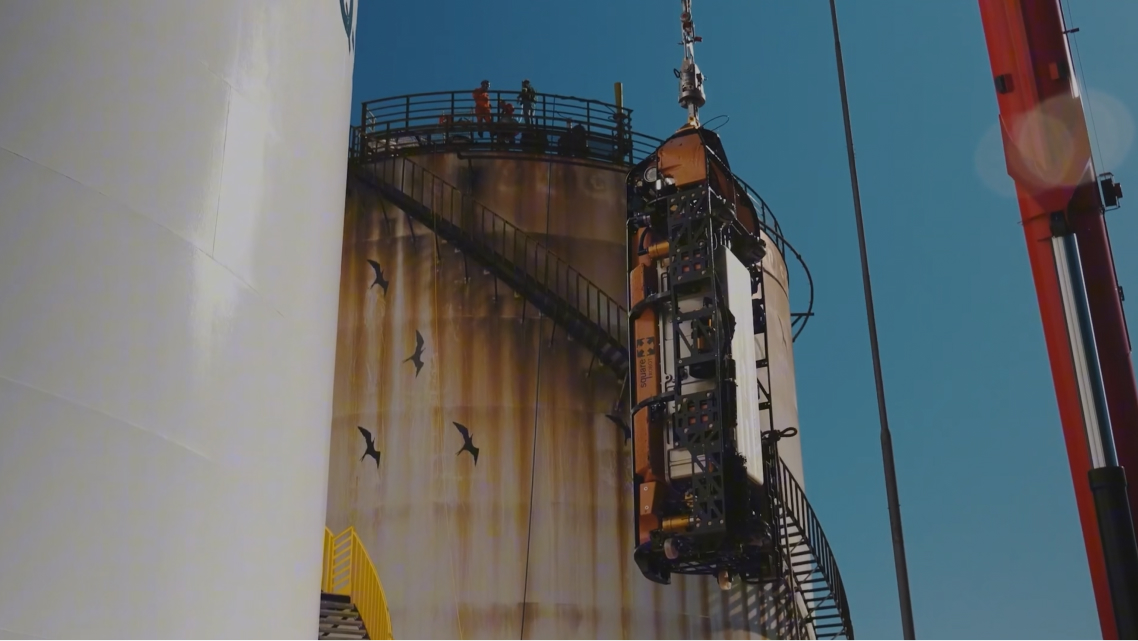
The SR-3 Platform
The SR-3
The World's Most Advanced Tank Inspection Robot

The World's Most Advanced Tank Inspection Robot
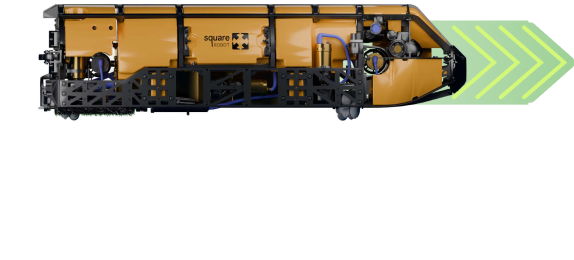
Square Robot's SR-3 is a fully autonomous, submersible inspection robot engineered to perform internal aboveground storage tank inspections while tanks remain online and fully in service.
API 653 and EEMUA 159 compliant. FM Approved.
No confined space entry required.

The SR-3 is engineered to operate in the challenging interior environments of aboveground storage tanks, navigates throughout the tank, positioning sensors for maximum coverage, and capturing the high-resolution data needed for API 653-compliant inspection reporting.


High-resolution, 256 element Phased Array Ultrasonic Transducer (PAUT) technology delivers accurate thickness measurements and corrosion mapping across the tank bottom and shell.
Square Robot's submersible is equipped with a sensor package that measures the tank bottom elevation as it traverses across the tank, building out a real-time elevation map of tank settlement to an accuracy of within a quarter of an inch. Utilize the SR-3 for the only comprehensive settlement analysis that can be performed while the tank stays online.
The SR-3 doesn't just improve inspection, it transforms it. Here's what changes when your tanks are inspected by Square Robot.


The SR-3 performs complete internal tank inspections without requiring a single worker to enter the tank, eliminating the most significant safety hazard in traditional inspection programs.
Because the SR-3 operates while the tank remains in service, often even inspecting while the tank is flowing, there is no need for shutdown, cleaning, or product removal. Inspections that once required weeks of preparation can now be completed in days.
The 256 element Phased Array Ultrasonic Transducer (PAUT) technology delivers thickness measurements and detailed corrosion mapping, gathering 10,000 UT readings per square foot to generate datasets that far exceed the accuracy of manual inspection methods.
Eliminating tank cleaning, product removal, degassing and production downtime translates directly to significant cost savings, often hundreds of thousands to millions of dollars per inspection.
Square Robot's autonomous, submersible inspection robot follows a structured, repeatable path, giving operators the ability to trend tank corrosion with more accurate data more frequent intervals.
Structured, digitized inspection data integrates with maintenance planning, risk-based inspection programs, and asset lifecycle management, giving operators a clearer picture of tank condition across their entire portfolio.
See how the SR-3 navigates tank environments, captures precision inspection data, and delivers results that meet the highest regulatory standards, without a single worker entering the tank.
The SR-3 is designed for flexible deployment, entering tanks through roof or shell manways or hatches depending on tank configuration, product type, and customer requirements. Both methods are engineered to maintain safety, minimize preparation time, and ensure a successful inspection.
The SR-3 is lowered into the tank through a 24 inch roof manway or hatch, one of the most common deployment methods for fixed-roof and external floating roof storage tanks. This approach minimizes the surface footprint of the inspection setup and reduces the time required for pre-inspection preparation.

Suitable for fixed-roof and external floating roof tanks
Minimal surface preparation required
Safe, controlled deployment process
The SR-3 can also be deployed through a side-shell manway, providing an effective solution for tanks where roof deployment is not suitable or where tank configuration favors side access.
Read More
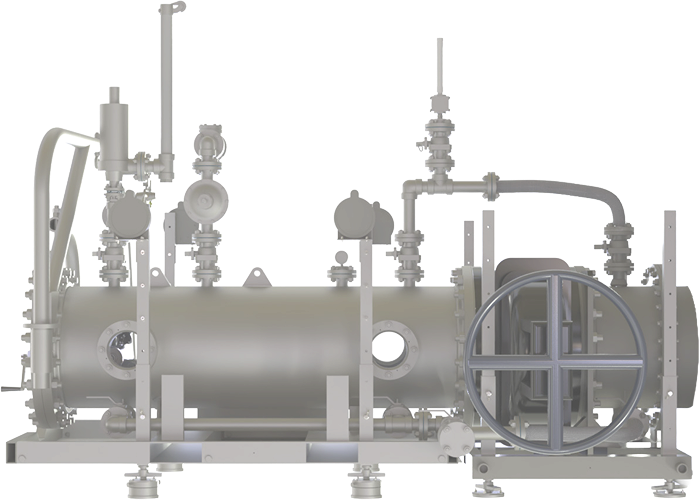
Compatible with tanks with internal floating roofs
Designed for the SR-3 to operate in C1D1 environments
Engineered for efficient entry and retrieval
Square Robot was founded on a single conviction: the most dangerous part of tank inspection, confined space entry, shouldn't be necessary. The SR-3 was engineered from the ground up to make that conviction a reality.
The SR-3 performs full internal tank inspections without requiring workers to enter to confined space, which has a disproportionately high risk rate according to OSHA.
Eliminate the need for multiple third parties and streamline inspections through Square Robot.
With no confined space crew required, the inspection site is safer, simpler to manage, and less demanding on health and safety resources.
The SR-3 inspection process is designed to satisfy API 653, EEMUA 159, and applicable jurisdictional requirements, with full documentation to support compliance audits.
FM Approval and other independent certifications confirm that Square Robot's technology meets rigorous third-party safety and performance standards.
Square Robot's SR-3 platform has earned independent validation through rigorous industry certification programs. Our credentials reflect the technical integrity of our inspection technology and the safety standards embedded in every deployment.
View All Patents


Traditional inspections require tanks to be taken out of service, emptied, cleaned, purged, and inspected manually. On-stream inspection with the SR-3 does all of this while the tank stays online, eliminating shutdown costs and confined space risk simultaneously.
Yes. SR-3 inspections are designed to support API 653 requirements for internal inspection of aboveground storage tanks, with structured data capture and reporting aligned to regulatory expectations.
The SR-3 is engineered for internal inspection of aboveground storage tanks while they remain in service, including tanks used in refining, terminals, and related applications—subject to site-specific suitability review.
Duration depends on tank size, configuration, and scope of the inspection program. Your team can provide a timeline estimate based on your specific assets and reporting requirements.
The robot weighs 265 lbs in air but achieves approximately 10 lbs of negative buoyancy when submerged in a distillate. An attached foam pack, configured with foam slices and ballast weights, ensures optimal performance. This setup allows the robot to rest on the tank floor, move smoothly along the bottom, and hover or navigate efficiently throughout the tank using its eight thrusters.
We communicate with the SR-3 via a fiber-optic cable that is attached to the inspection robot at all times.
We capture video footage from two high-definition cameras on the robot and extract still images from the recorded footage of key areas of interest that we include in the final report. However, image quality can be affected by visibility within the product.